jusqu'à 1Go de cache !
keynote complet
https://www.servethehome.com/amd-advancing-ai-2026-keynote-live-coverage/

Graviton5 really delivered with some solid generational gains. M
aintaining the same 16 vCPU "4xlarge" count, there was 30% geo mean uplift from Graviton4 to Graviton5 across all of these independent benchmarks carried out using m8g.4xlarge to m9g.4xlarge.
Graviton5 (...) bump to DDR5-8800 from DDR5-5600
(il gagne quand même 500mhz au passage
c'est quand même vraiment bien, il va se rapprocher des CPU x86 dangereusement
GPU pour serveur
solide
Mais que via http
ou https://www.storagereview.com/news/e2-ssd-form-factor
1Po !
en 200mm x 76mm x 9.5mm
PCI-E 6.0 !
80w par SSD
This size is ideal for dense storage servers, accommodating up to 40 E2 SSDs in a 2U node,
which can translate to up to 40 PB in a single server
Intel semble être revenu dans la course (niveau serveur)
jusqu'à 128coeurs Haute performance, ou 288 coeurs efficients.
Quelques benchmarks des 6700P/6500p
https://www.servethehome.com/intel-xeon-6700p-and-6500p-granite-rapids-sp-for-the-masses-initial-benchmarks-and-first-look/4/
et surtout des 6900P
https://www.servethehome.com/welcome-back-intel-xeon-6900p-reasserts-intel-server-leadership/5/
"No longer will the question be 64 EPYC cores versus 28 Xeon cores, or 96 EPYC cores versus 64 Xeon cores.
Intel is back in the game"
SoC – Intel Processor N150 quad-core “Twin Lake” processor @ up to 3.6 GHz (Turbo) with 6MB cache, 24EU Intel UHD graphics @ 1000 MHz; TDP: 6W (up to 25W)
Memory – Up to 32GB DDR5-4800 SO-DIMM memory (single socket)
Storage
2x M.2 2280 NVMe SSD sockets; one fitted with up to 1TB SSD when ordering
2.5-inch SATA SSD/HDD slot
MicroSD card slot
Pas mal pour un serveur/ pare-feu et switch
182€
pas mal
il y a de l'amélioration surtout en terme de perf/watts
mais le 128 cœurs AMD reste devant
Windows Server Hotpatching pour tous
Active Directory et SMB de nouvelle génération
Données et stockage critiques
Hyper-V et IA
https://www.techpowerup.com/313953/intel-5th-gen-xeon-platinum-8580-cpu-details-leaked
https://www.servethehome.com/5th-gen-intel-xeon-scalable-overview-at-intel-innovation-2023/
5th Gen Intel Xeon Scalable Emerald Rapids at Intel Innovation 2023
Intel says that the new generation of processors will be its last in the current sockets before moving to the much larger Birch Stream platform that will take Granite Rapids (P-core 2024), Sierra Forest (E-core 2024), and Clearwater Forest (E-core 2025.)
This is the generation where we expect Intel to hit 64 cores and we also expect improvements to DDR5 memory speeds.
https://www.servethehome.com/5th-gen-intel-xeon-scalable-emerald-rapids-launches-on-december-14/
https://www.tomshardware.com/news/intel-will-adopt-3d-stacked-cache-for-cpus-says-ceo-pat-gelsinger
The new 288-core model isn’t entirely surprising, as the company’s Granite Rapids architecture, (...), can accommodate up to three compute chiplets packed with cores.
As such, Intel can pack 144 E-cores into a single chiplet.
(mais pas pour de suite)
https://www.servethehome.com/intel-announces-288-e-core-sierra-forest-variant-at-innovation-2023/
the AMD EPYC 9754 is the flagship part with 128 cores and 256 threads at $11,900
The primary change for Zen 4c cores from Zen 4 is a halving of L3 cache.
The AMD EPYC 9754 is showing performance ~3x a 128-core Arm competitor at 1.5x the power.
An AMD EPYC 9754 is often twice the performance of 2019’s AMD EPYC 7002 “Rome” 64-core parts.
On most non-HPC-focused workloads, expect the AMD EPYC 9754 to be 15-20% faster than the AMD EPYC 9654. That is not a straight 33% as we would expect due to the core count increase, but AMD is getting scaling from the increased core count even with a drastically reduced L3 cache size.
AMD seems to have figured out an elegant way to reduce turbo clock jitter, especially at maximum load. That helps a lot with SLA on a loaded system.
Cloud-native processors will make up a huge segment of the market.
cette image avec tout ces cœurs ^^ :
https://www.servethehome.com/wp-content/uploads/2023/07/AMD-EPYC-9754-Stress-for-CPU-Frequency-22.5hr-Stress.jpg
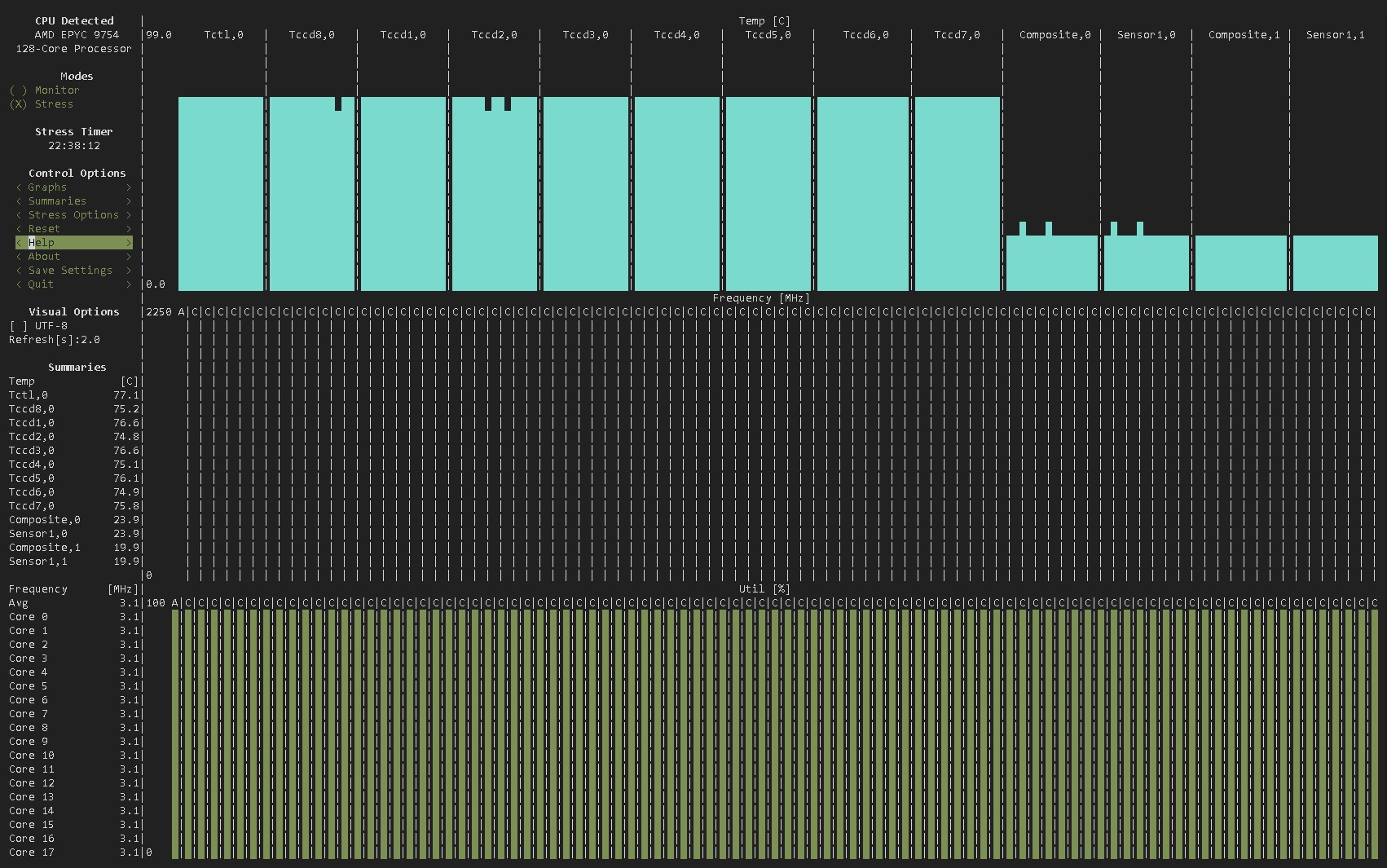
sur son infra il a choisir une carte mère intel xeon mais à 35w de TDP pour 4coeurs/8thread !
https://www.supermicro.com/en/products/motherboard/X10SDV-4C-TLN4F
c'est un super choix en fait !
supermicro fait des super carte mère et chassis
par exemple celui ci, en xéon, mais il faudrait remplacer les ventilos (à voir pour le bruit) mais ça supporte des alim DC !
https://www.servethehome.com/supermicro-e300-9d-4cn8tp-review-a-4x-10gbe-and-4x-1gbe-server/
https://www.supermicro.com/en/products/motherboard/X10SDV-4C-TLN4F
ou intel Atom Cxx en 16coeurs ! (1000€ snif) :
https://www.supermicro.com/en/products/motherboard/a2sdi-16c+-hln4f
ou encore en AMD Epyc 8coeurs 30w de TDP ! :
https://www.servethehome.com/supermicro-m11sdv-8ct-ln4f-review-with-amd-epyc-3201-in-mitx/
https://www.supermicro.com/en/products/motherboard/m11sdv-8ct-ln4f
malheureusement les prix sont plutôt salés.
mais ça serait le serveur perso ultime !
sympa la doc Framasoft (même si pas mal de choses sont déjà vue, d'autre sont plutôt sympa)
soit disant plus perf et efficient que le futur AMD Epyc à 96 coeurs
à voir
https://www.phoronix.com/review/ampereone-192-cores
ah voila le comparatif serait foireux :
https://www.tomshardware.com/news/ampere-unveils-192-core-cpu
144 coeurs ! ("basse conso" donc du Atom très amélioré) :
https://www.tomshardware.com/news/intel-roadmap-update-includes-144-core-sierra-forest-clearwater-forest-in-2025