le 855 est bien devant.

prochain SOC ARM
32c 64T qui s'annonce bien plus perf
https://images.anandtech.com/graphs/graph13959/106740.png
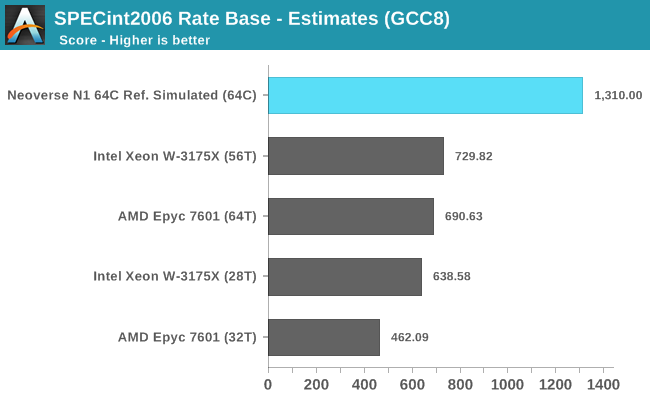
https://www.cnx-software.com/2019/02/21/arm-neoverse-e1-n1-processors-edge-cloud-infrastructure/
http://www.comptoir-hardware.com/actus/processeurs/38345-des-bons-gros-cpu-pour-serveurs-chez-arm-les-n1-et-e1.html
Pinebook Pro laptop preliminary specifications:
SoC – Rockchip RK3399 big.LITTLE hexacore Arm Cortex A72/A53 SoC
System Memory – 4GB LPDDR4 RAM
Storage – 64GB/128GB of eMMC flash (128GB is a free upgrade for registered users of Pine64 forum), SD card slot
Display – 14″ 1080p IPS LCD panel
Video Output – Via USB-C up to 4K60hz
Audio – Aux out, microphone, speakers
Connectivity – 802.11ac WiFi and Bluetooth 4.2
USB – USB 3.0 and USB 2.0 ports
Camera – 2MP front-facing camera / webcam
Serial – UART
Expansion – PCIe x4 that can take a m.2 NVMe SSD using an optional adapter
Battery – 10,000 mAh capacity battery
Power Supply – Charging via barrel port or USB-C
Black magnesium alloy body
ça parait trop beau !
CPU – 64x Armv8 cores clocked at up to 2.6 Ghz delivering a 930 SPECint score
Memory I/F – 8x DDR4 @ 2933 MHz for 6 to 8 channels memory
Storage – 16x SAS/SATA interfaces
High Speed Interfaces – 40x PCIe 4.0 including 16 that can be used for CCIX (Cache Coherent Interconnect for Accelerators); 640 Gbps total bandwidth
Networking – 2x 100G RoCE (RDMA over Converged Ethernet)
Process – 7nm process
https://www.cnx-software.com/2019/01/07/huawei-kunpeng920-64-core-armv8-server/
4x Cortex A73 @ 2.0/2.1GHz
4x Cortex A53 @ 2.0GHz
Hi1620
Cores 24 to 64
Architecture Ares
Frequency (GHz) 2.4 to 3.0
Memory 8x DDR4-3200 4x DDR4-2400
2 x 100 GE 46 PCIe 3.0
8 x 10GE 16 PCIe 3.0
Process TSMC 7nm
Power 100 to 200 W
http://wiki.radxa.com/Rockpi4/getting_started#
https://www.cnx-software.com/2018/11/08/rock-pi-4-raspberry-pi-rk3399-board/
SoC – Rockchip RK3399 big.LITTLE hexa-core processor with 2x Arm Cortex-A72 @ up to 1.8 GHz, 4x Cortex-A53 @ up to 1.4 GHz, a Mali-T864 GPU with support OpenGL ES1.1/2.0/3.0/3.1, OpenVG1.1, OpenCL, DX11, and AFBC, and a VPU with 4K VP9 and 4K 10-bit H265/H264 decoding
System Memory – 1, 2 or 4GB LPDDR4 @ 3200 Mbps
Storage – eMMC module socket, micro SD card slot up to 128GB, M.2 NVME SSD socket
Video Output / Display Interface
HDMI 2.0a up to 4K @ 60 Hz
2-lane MIPI DSI via FPC connector
Dual independent display support
Audio – Via HDMI and 3.5mm audio jack; HD codec supporting up to 24-bit/96Khz audio
Camera – MIPI-CSI2 connector for camera up to 8MP
Connectivity
Rock Pi 4A – Gigabit Ethernet
Rock Pi 4B – Gigabit Ethernet with PoE support (additional HAT required), 802.11ac WiFi 5, Bluetooth 5.0 with on-board antenna
USB – 1x USB 3.0 host port, 1x USB 3.0 OTG port, 2x USB 2.0 host ports
Expansion – 40-pin expansion header with 1x UART, 2x SPI bus, 2x I2C bus, 1x PCM/I2S, 1x SPDIF, 1x PWM, 1x ADC, 6x GPIO, and power signals (5V, 3.3V and GND)
Misc – RTC
Power Supply – Via USB-C port supporting USB PD 2.0 (9V/2A, 12V/2A, 15V/2A, or 20V/2A) and Qualcomm Quick Charge 3.0/.0 (9V/2A, 12V/1.5A). It’s also possible to power the power via a 5V/3.4A power adapter, but it is not recommended
Dimensions – 85 x 54 mm
So the only real difference between model A and model B is the latter includes a wireless module, and optional support for PoE.
vraiment pas mal pour le prix (à partir de 39$)